No Wondering Walker
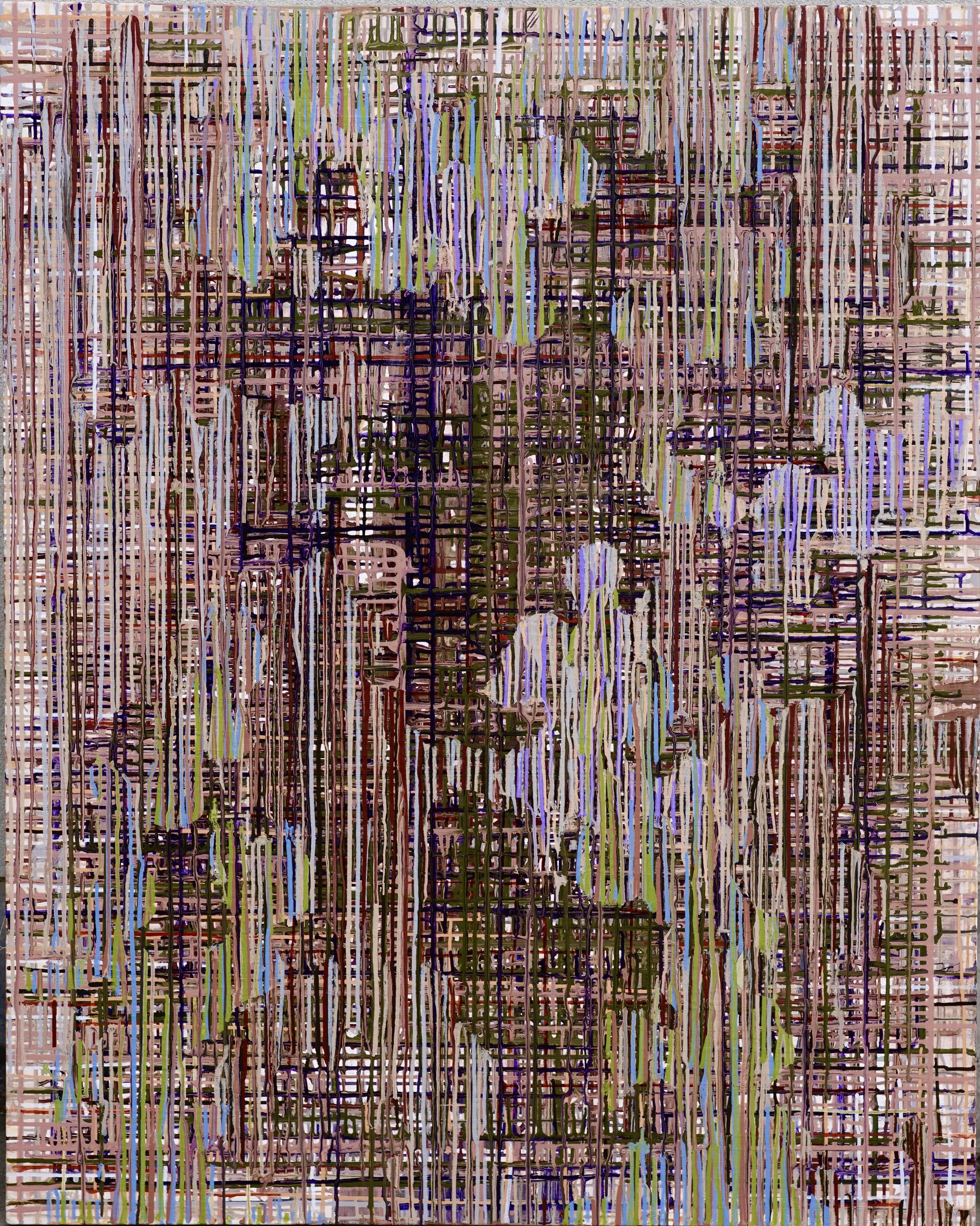
No Wondering Walker, 2021, Acrylic on canvas, 60 x 48 inches
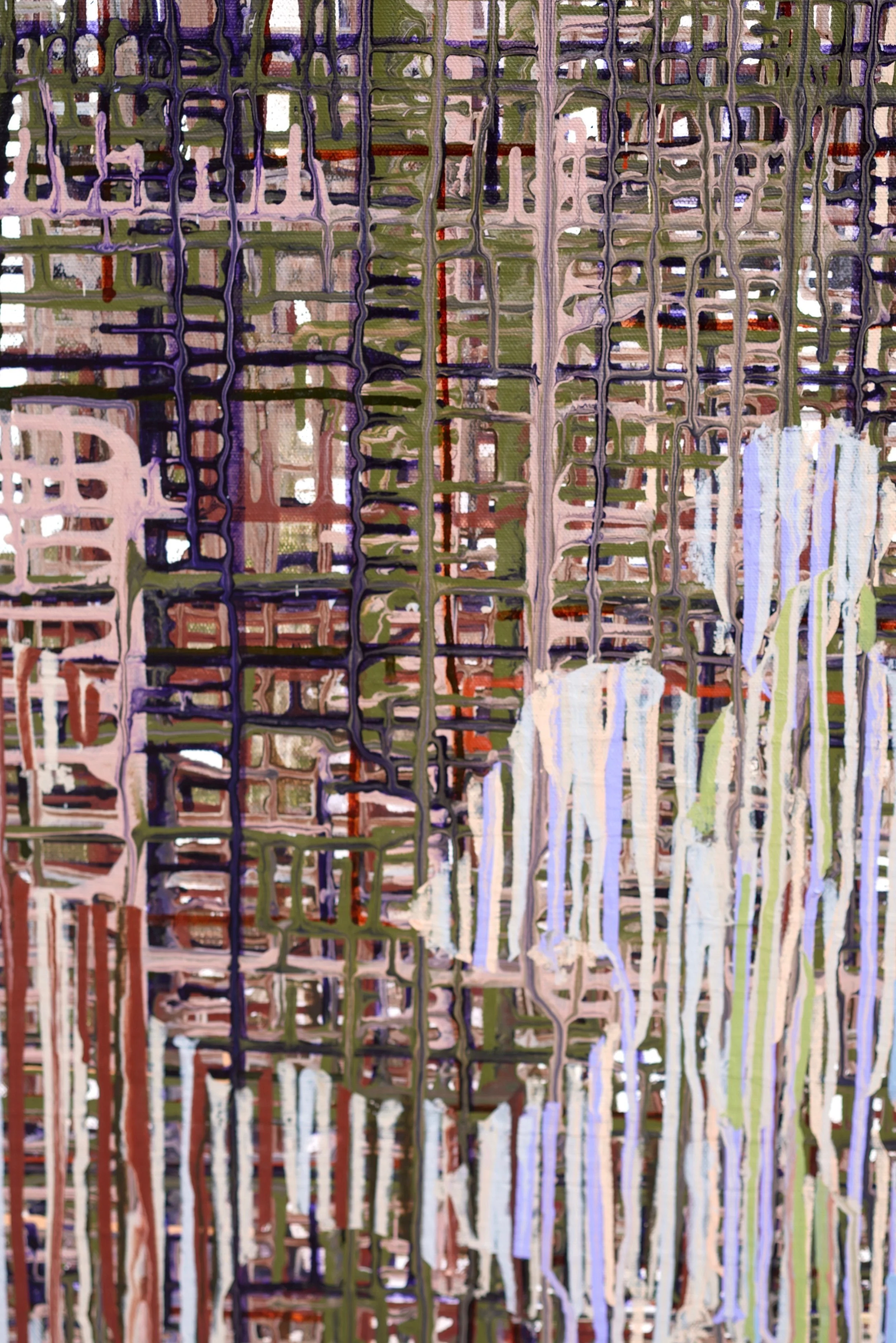
Using the canvas as my body, I create a linear perception system. In these longitudinal grids, I attempt to observe, interpret, experiment and reproduce the body and brain as an external observer in shaping the physical experience of the dream. This painting is based on a conceptual framework of the phenomenology of self-experience in dreams by referring to Jennifer M. Windt's description of the conscious experience in dreams as a functional non-physical state of dreaming (Windt 349-398). I draw layered pictures at scheduled intervals using fragmented time management and meditation to control external stimuli and input from the body. I try to interrupt the systematic life cycle regarding waking experiences by simulating selfhood in dreams and across the sleep-wake cycle from behavioural patterns and subconscious projections.
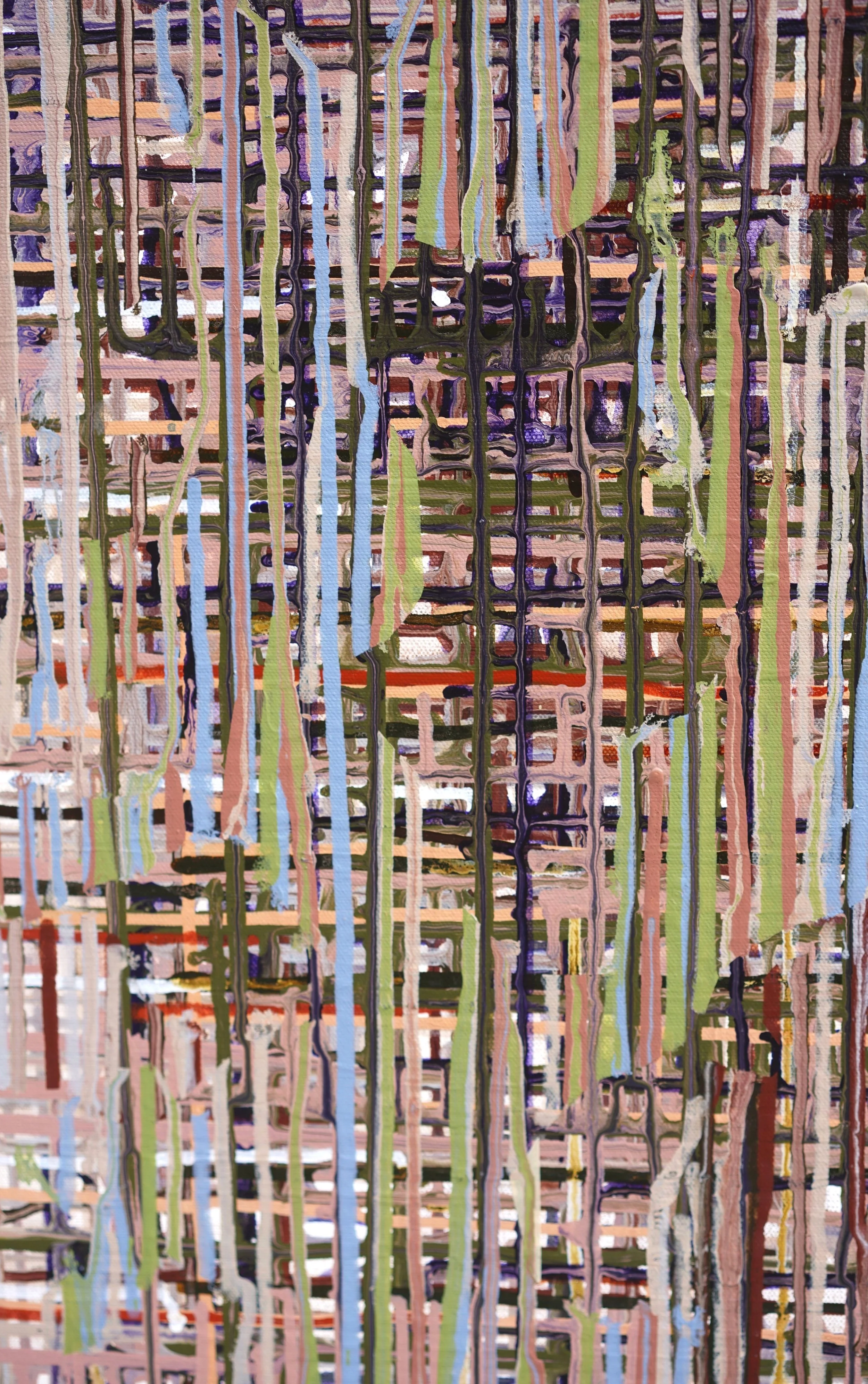
The overall image comprises several layers of reticulated and linear elements that overlap and intersect above and below and intermingle in the same plane. I think about the body-brain-body problem, which deals with the functional relationship between bodily experience, brain activity and the body. This relationship is built on multiple levels and dimensions, with the body's past, present and future changing as thought guides and consciousness travels. I use different layers of saturation and brightness to express the body's perception of it. Meanwhile, a particular variant of the mind-body problem I am discussing is shown in a vertical line figure without borders but is subject to limitations. It is metaphorically conceived as an imaginary bodily experience arising in a dream, which is not hallucinatory but a dysfunctional state that is not recognizable or identifiable.
I do not use manipulative tools such as brushes; the pigments are diluted and dripped onto the canvas in squeezing bottles. Instead, to convey the experience of dreams, perception, imagination, delusion and self-consciousness, I use the autonomous fluidity of the paint to mimic the temporary decoupling of sensory input from the actual environment by releasing it. At the same time, the lifting motion of the frame limits my bodily perception.
Before starting to paint, I refer to Gerhard Richer's personal experience. He talks about how the starting point of the painting is always only ignorance, with some frivolous and weightless ideas of ignorance and the idea of finding figurative reality among abstraction. I tried to blank myself out and took the first step towards destroying its rationality (Richter et al.). When I close my eyes and drop the paint on the canvas, my mind seems to be withdrawn from my body and presented in a dream world. As I lift the frame, the paint flows slowly, and the physical experience acts on how I interact with space, which is then mapped to a change in the causal coupling between the brain and the unconscious body.
While working on this painting, I have been reflecting on the direct and intimate sensory connection I have established with the image, feeling the almost entirely abstract, theme-less indeterminate form of the image. I have attempted to feedback on the quasi-perceptual experience of the dream in terms of the rhythm of specific colours and the meaning of lines. When I observe the delicate handling and anfractuosity between colours, I am reminded of the closest waking state to dreaming-imagination or fantasy, where my physical experience is as intertwined with the paint in time and space.